The Price of Truth: Why Fullmetal Alchemist is the Perfect Story
Is "Equivalent Exchange" a law of the universe, or a lie? We analyze the philosophy of Hiromu Arakawa’s Fullmetal Alchemist, the corruption of the Seven Deadly Sins, and why the ending is the most satisfying in anime history.
The Law of Equivalent Exchange
"Humankind cannot gain anything without first giving something in return."
This is the first line of the show. It sounds like a law of physics. If you want to build a house, you need wood and stone. If you want to bring back the dead... well, the price is higher than you can pay.
Edward and Alphonse Elric learn this the hard way. They lose their bodies trying to play God. The entire series is a quest to get them back.
But as the story progresses, Hiromu Arakawa deconstructs her own rule. She asks: Is the world really just a transaction? Or is love something that is given without expecting anything in return?
The Seven Deadly Sins (Deconstructed)
The villains in FMA—the Homunculi—are literal manifestations of human flaws: Lust, Greed, Envy, Wrath, Pride, Gluttony, and Sloth.
But Arakawa writes them with incredible nuance.
- Greed wants everything, but eventually realizes that what he really wanted was friends.
- Envy hates humans, but deep down, he is jealous of our ability to support each other.
The heroes defeat the villains not just by punching harder, but by accepting their own humanity—flaws and all.
Read the Details: The manga explains the alchemy system and the politics of Amestris in even greater detail than the anime. The Fullmetal Edition (Hardcover) is the definitive way to own this masterpiece.
God vs. The Truth
Most Shonen anime end with the hero becoming the strongest being in the universe (God). Fullmetal Alchemist does the opposite.
Edward defeats the final villain ("Father," who tries to become God) by acknowledging that he is just a regular human. In the final trade with "Truth," Edward gives up his alchemy—his power, his identity—to save his brother.
He proves that being a simple human with a family is more valuable than holding the power of a god. It is an ending that rejects power fantasies in favor of genuine happiness.
Conclusion: A Lesson in Value
Fullmetal Alchemist remains the highest-rated anime of all time because it respects the viewer. It doesn't use cheap tricks. It tells a complete, circular story about growing up, accepting loss, and moving forward.
It teaches us that we don't need alchemy to change our lives. We just need the resolve to move our two legs forward.
Complete the Set: This series looks stunning on a shelf. Grab the Fullmetal Alchemist Complete Box Set on Amazon.
Do you believe in Equivalent Exchange in real life? Let’s discuss philosophy in the comments!
You Might Also Like
View All→
The Tragedy of Geto Suguru: When Being "The Strongest" Isn't Enough
"Are you the strongest because you are Gojo Satoru? Or are you Gojo Satoru because you are the strongest?" We analyze the heartbreaking descent of Geto Suguru and why he is the most tragic villain in Jujutsu Kaisen.
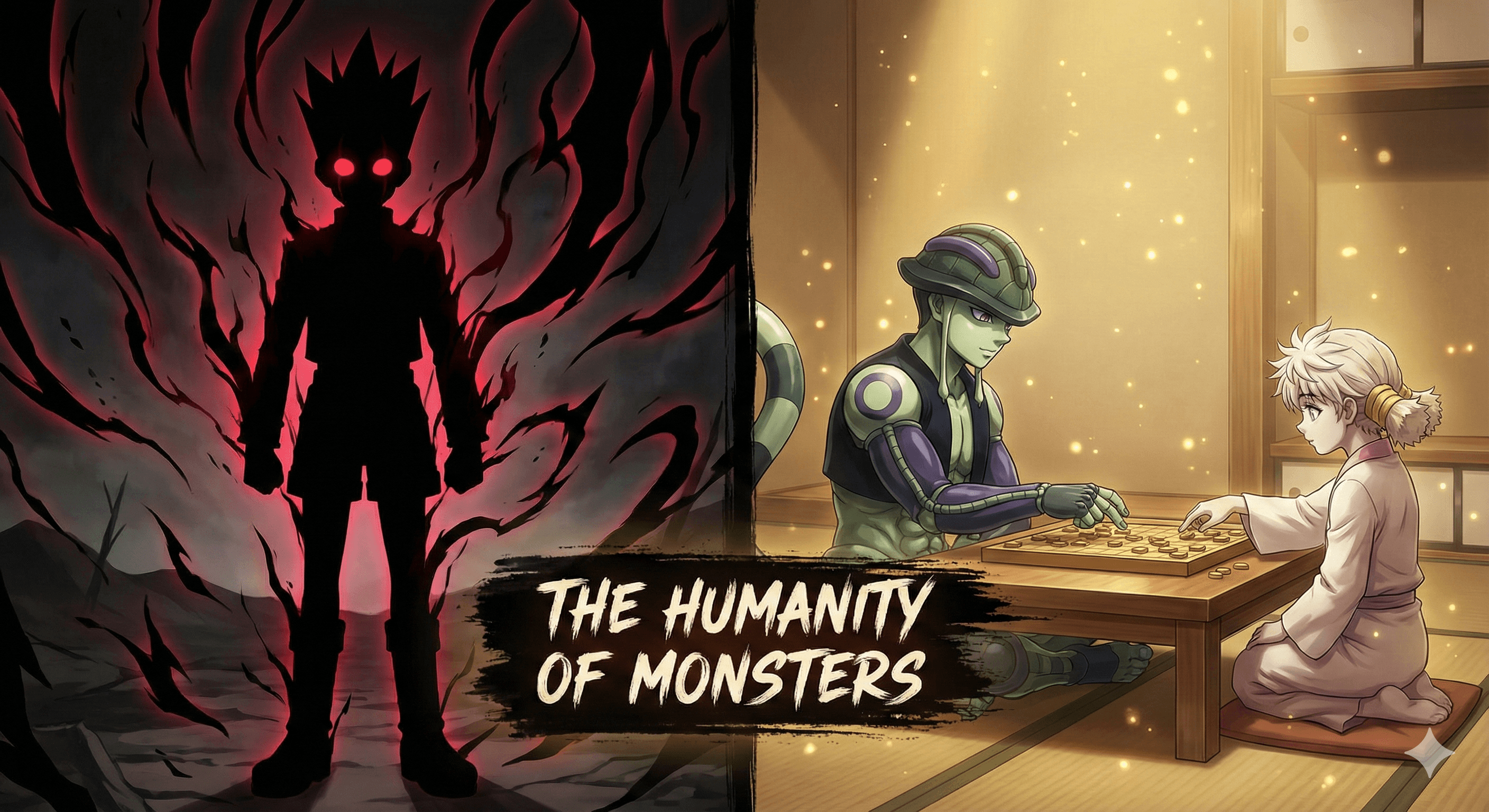
Humanity vs. Monsters: Why the Chimera Ant Arc is the Peak of Shonen Storytelling
It starts as a battle against bugs and ends as a philosophical tragedy. We analyze the duality of Gon Freecss and Meruem in Hunter x Hunter, exploring how Yoshihiro Togashi deconstructed the genre to ask: Who are the real monsters?

"I Have No Enemies": Why Vinland Saga is the Antidote to Modern Shonen
Most anime teach you to fight harder. Vinland Saga teaches you that fighting is pointless. We analyze Thorfinn’s journey from a rage-filled viking to a true warrior, and why his philosophy is life-changing.
📚 Enjoying our content? Explore by category or browse all articles